Lost on Purpose: How the Greatest Comedy Moments Are Born From Deliberate Confusion
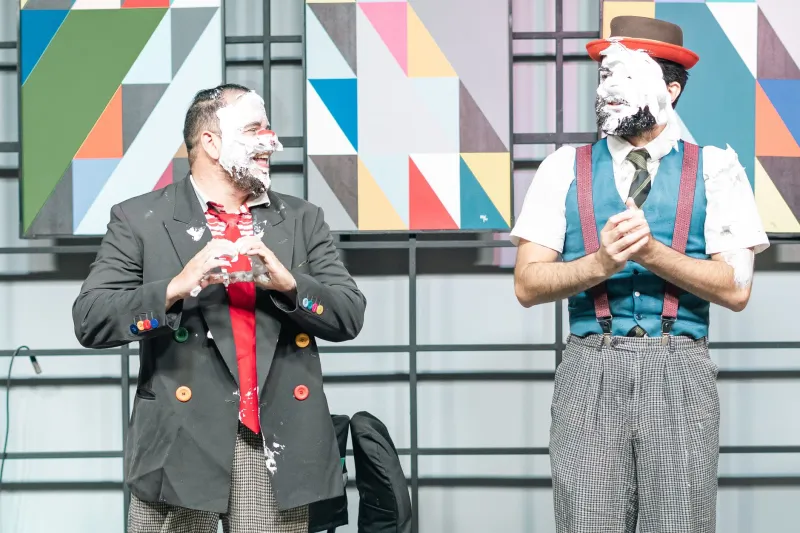
There's a specific expression that washes over a festival crowd right before something transcendent happens. It's not laughter. It's not discomfort exactly. It's the face people make when their brain has quietly filed a missing persons report on the punchline and isn't sure whether to panic.
That expression — somewhere between "wait, what?" and "I think I'm having a great time?" — is the whole ballgame for a particular breed of comedian. And at festivals like this one, where weird is less a genre than a operating system, that manufactured uncertainty isn't a bug. It's the entire architecture.
The Joke Structure Is a Lie (A Useful One)
Most of us grew up absorbing comedy through a pretty reliable delivery mechanism: setup, escalation, punchline. It's the narrative equivalent of a highway on-ramp — comfortable, predictable, gets you where you're going. The problem, as alternative comics have known for decades, is that predictability is the enemy of surprise, and surprise is basically the only raw material comedy actually runs on.
When an audience can feel the punchline approaching from three blocks away, the laugh they produce is polite at best. It's the comedy equivalent of saying "good, thanks" when someone asks how you're doing. Technically a response. Emotionally inert.
What the best performers in the alternative circuit understand — and what gets road-tested relentlessly on stages exactly like the ones at this festival — is that confusion, deployed with surgical precision, creates a kind of attentional vacuum. The audience leans in. Their pattern-recognition software starts working overtime. And when the payoff finally arrives, or deliberately doesn't, the emotional release is proportionally enormous.
"You're basically borrowing from their future," one comic described it backstage at a recent festival night. "You're asking them to stay in a weird uncomfortable place a little longer than feels safe, and then either you pay them back with interest or you make them realize the discomfort was the point the whole time."
Misdirection as a Love Language
Magicians figured this out centuries before comedians caught up. Misdirection isn't deception for its own sake — it's a form of directed attention, a way of making someone look so hard at one thing that everything else becomes invisible. Alternative comedy has essentially stolen this trick wholesale and refused to return it.
The difference is that a magician reveals the rabbit. A lot of the best weird comedy never does.
Consider the particular genius of a bit that spends four minutes building an elaborate, internally consistent premise about something completely mundane — let's say, the bureaucratic process of renaming a parking lot — only to arrive at a conclusion that's either profound, absurd, or both simultaneously. The audience has been so busy trying to locate the "real" joke that by the time they realize the parking lot was always the joke, they've emotionally invested in a way no straightforward setup ever could have achieved.
This is what festival audiences get that general admission crowds at a comedy club sometimes don't: they've self-selected for the willingness to be taken somewhere strange. They bought the ticket knowing the destination wasn't printed on it.
The Psychology of Not Knowing (And Loving It)
Researchers who study humor — and yes, that's a job, and yes, it probably sounds more fun than it actually is — have documented something they sometimes call "benign violation theory." The short version: things are funny when they violate our expectations in a way that simultaneously feels safe. The brain registers the wrongness, confirms there's no actual threat, and converts that tension directly into laughter.
Alternative comedy essentially stress-tests this theory by extending the "wait, is this safe?" phase as long as possible before the release. The comics who do this best aren't being reckless — they're being extraordinarily precise. The confusion has to feel like it's going somewhere, even when it isn't. There's a difference between a bit that's lost and a bit that's deliberately, expertly, going nowhere as a destination.
Audiences can feel that difference in their bones. They might not be able to articulate it, but they know when a performer is confused versus when a performer is in complete control of their confusion. The former is painful. The latter is the closest live comedy gets to magic.
Festival Stages as Laboratories for the Inexplicable
This is part of why the festival format matters so much for this kind of work. A comic doing a tight twenty at a club has limited runway for experimentation. The audience came for laughs per minute, not for a philosophical journey through the nature of expectations. The social contract is clear and fairly inflexible.
A festival set — especially at an event built around alternative sensibilities — operates under a different agreement entirely. The audience has essentially signed a waiver. They know they might see something that confuses them, challenges them, or sends them home needing to call a friend and process what they witnessed. That's not a warning. That's the pitch.
For comics, that freedom is genuinely rare and genuinely intoxicating. It's the difference between cooking for a client who wants a burger and cooking for a table of adventurous diners who told you to just do something interesting. The creative latitude changes everything.
"I have bits I've only ever done at festivals," one performer admitted, "because they require the audience to follow me somewhere weird for like six minutes before anything resolves, and most rooms won't give you that. Festival crowds will. They're different. They show up ready."
The Audience as Co-Conspirators
Here's the part that often goes unacknowledged: the audience isn't passive in this transaction. When a comedian leads a room into genuine uncertainty and the room stays with them — doesn't bail, doesn't groan, doesn't start checking phones — that crowd has made an active choice. They've decided to trust the performer, to extend credit, to keep their interpretation options open.
That collective decision is its own kind of performance. The best festival moments aren't just about what's happening on stage; they're about 300 people simultaneously agreeing to be confused together, which is a profoundly weird and deeply human thing to do.
When it works, the laughter that finally emerges isn't just a response to a joke. It's relief, recognition, shared bewilderment transformed into joy. It's the sound a room makes when it realizes it took a leap and the ground was there the whole time — or that the falling itself was the destination.
That's the unspoken contract. Show up ready to not know what's coming. Trust the weird. The best stuff lives in the gap between the setup and wherever the hell this is going.
And honestly? That gap is exactly where we want you.